📸 INSERT HERO IMAGE HERE
Casual personal photo of Adaeze (your blog persona) in a home setting.
Ideal size: 800 x 500px. Real, warm, unposed.
You called his name again this morning.
Not once. Not twice. Three times — and he still didn't move.
So you raised your voice. Then raised it again. And somewhere between the second shout and the third, something in your chest just... sank.
What is wrong with this child? Why won't he just listen to me?
You love your children more than anything in this world. You sacrifice for them every single day. You wake up before them. You sleep after them. You carry their problems like they are your own skin.
And yet — your child looks you straight in the eye and acts like your voice means absolutely nothing.
His class teacher has called you. Again. "His focus is poor. He is not completing his work. He argues when corrected." You drove home from that meeting feeling like the road was shaking under you.
You have tried everything. You took the tablet away. You flogged him. You threatened to send him to the village. You fasted and prayed over him at night when he was sleeping — hoping God would just fix whatever you were too tired to fix yourself.
God, what am I doing wrong?
You have watched other children. In church. In your neighbourhood. Children who sit quietly, greet elders without being told, do their homework without a fight. And you have wondered — what do those mothers know that nobody told me?
The shame of it is the worst part. Because in this our culture, a child's behaviour is a reflection of you. When your child misbehaves in public, it is your name people whisper. Not his.
You are not just physically tired. You are emotionally exhausted. The kind of tired that sleep cannot touch. The kind that sits in your chest like a stone.
I know this feeling. I lived it. Not long ago, I was sitting on my kitchen floor crying quietly — making sure the children couldn't hear me — wondering if I was simply not made for this.
Drop everything you are doing now and listen to every word I'm about to say.
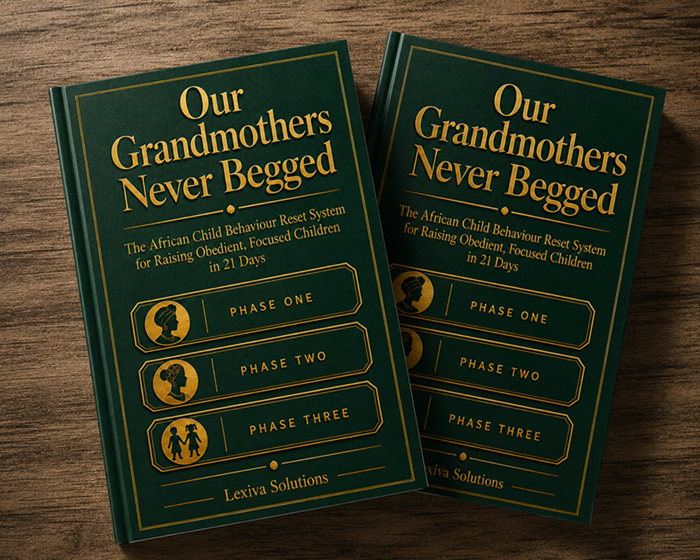
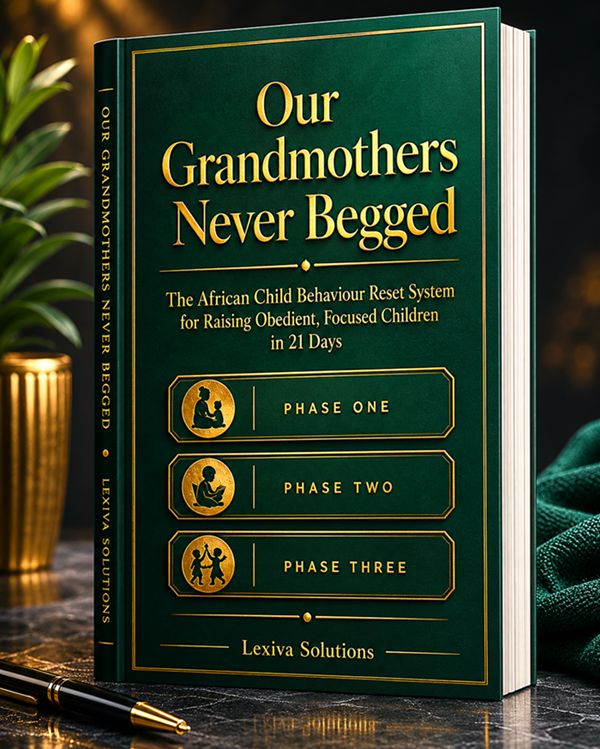
Our grandmothers never begged their children.
They never negotiated with a seven-year-old. They never threatened to count to three and then did nothing when they reached it. They never cried in the bathroom because they had run out of ideas. Their children obeyed them — not from fear alone, but from something deeper. Something that has quietly been lost as we rushed into modern life.
It is not something you find in a Western parenting book. It is not in a YouTube video or an Instagram parenting page. It was carried in the hands and voices of the women who came before us — and one 81-year-old woman from Edo State handed it back to me on a rainy Tuesday afternoon.
Hi. My name is Adaeze Okonkwo.
The first thing you should know about me: I am NOT a child psychologist. I am not a parenting coach. I have no degree on my wall that qualifies me to advise anyone. I am just a 35-year-old mother of two from Anambra State, living in Lagos — who spent three painful years not understanding why her children wouldn't listen — until one chance encounter changed my entire home.
📸 INSERT SECOND PERSONA PHOTO HERE
A casual photo of Adaeze — perhaps with children, or reading in a home setting.
Ideal size: 600 x 400px. Warm, natural, real.
Let me take you back to where this really begins.
My first son, Emeka, was born in 2017. Easy baby. Bright eyes. Curious about everything. I held him in that hospital bed and thought: I was made for this. I am going to be the mother I always wished I had.
By the time he was four, he had discovered the tablet.
And slowly — the way these things always happen slowly — it took him. My bright, curious boy started drifting. His attention got shorter. His temper got shorter. He started ignoring me mid-sentence. Walking away while I was still talking. Acting as if my voice was just... background noise.
I told myself it was a phase. Every mother says this. We tell ourselves this until we run out of time to keep saying it.
When my daughter Chinwe arrived two years later, I had even less time to monitor Emeka. By the time he entered Primary Two, his class teacher called me in.
"Mrs Okonkwo, your son is bright. But he cannot focus. He does not complete his work. And when I correct him, he argues with me."
I drove home that day with my hands tight on the steering wheel and something hollow opening in my chest.
My marriage felt it too.
My husband Chike is a patient man. But patient men have limits. He started coming home late more often. Stopped asking for updates on the children because every update I had was a complaint. The silence between us at dinner became its own kind of conversation.
One evening, after I had screamed myself raw trying to get Emeka to do his homework, Chike looked at me and said quietly: "Ada. Something has to change. I don't know what — but something."
He wasn't being cruel. He was being honest. But those words landed like a stone dropped into still water.
That night I sat on the kitchen floor after the children slept and I cried. Not dramatically. Just quietly. The way a woman cries when she is genuinely out of answers.
The next morning, I called my godmother Mama Ngozi — a woman who raised eight children without ever raising her voice above a certain tone and whose grandchildren still call her every Sunday without fail.
"Adaeze," she said, "a child who is not connected to you will not obey you. Obedience follows connection. That is what you are missing. The cord between you is broken."
I didn't fully understand her. But those words stayed with me.
I tried everything after that call.
1. The reward chart system. I saw it on a parenting Instagram page. Gold stickers for good behaviour. It lasted eleven days. Then Emeka decided he didn't care about the stickers anymore — and I had nothing left to threaten him with.
2. Screen time locks and parental control apps. I locked the tablet. He found my phone and watched YouTube on it instead. The first evening I took the phone away, he cried for forty minutes. The house felt like a war zone from that point every single evening.
3. A private tutor. N25,000 a month. After eight weeks, the tutor told me gently: "Madam, the boy is not dull. But something in the home environment is affecting his ability to focus. I cannot fix that in two hours a week."
4. A child counsellor. She gave me a workbook full of theories that assumed I had unlimited time, a child who would cooperate by choice, and a home that looked nothing like mine.
5. Sending him to my mother in the village for a month. He came back calmer. It lasted three weeks. Then everything returned. Because the root cause had never been touched.
6. Prayer and fasting. I love God deeply. But I also came to understand that God gives us wisdom and tools — and I had not yet found the right tools.
I was running out of options. And I was running out of myself.
Then came the Tuesday that changed my life.
My husband's aunt — Mama Ehi — was visiting Lagos from Benin City. She is 81 years old. Small woman. Slow walk. Eyes that see everything and miss nothing. She raised seven children in Edo State alone after losing her husband early — and every single one of those children went to university, is responsible, and phones her without fail every Sunday.
We were sitting in the parlour after lunch. The children were nearby. Emeka had the tablet and was ignoring everything. I called his name. He mumbled something without looking up.
I saw Mama Ehi watching. Then she looked at me. Then looked away.
Later that night, when the children were in bed, she called me to sit with her. She took my hand the way old women do — firmly, like they are passing something through the touch itself.
"You are fighting your son," she said. "Every day. And neither of you is winning. That is because you are using the wrong weapon."
I asked her what she meant.
"Shouting is not discipline. Flogging without connection is just pain — it teaches nothing that lasts. A child obeys the mother whose presence he can feel — even when she is in the next room. You must rebuild the invisible cord. Once that cord is strong, you don't shout. You don't beg. You speak — and he listens. Because he feels you."
I stared at her. The cord. That was it. That was exactly what Mama Ngozi had tried to tell me.
"How?" I asked. "How do I rebuild it?"
And Mama Ehi smiled — the slow, certain smile of a woman who has been waiting a long time to be asked exactly this question.
She talked for two hours. About morning rituals. About the way you speak a child's name. About what happens in the evening before bed that determines the next day. About consequences that teach rather than terrorise. About the Edo way of raising children — what her own mother passed to her, and her mother's mother before that.
The things she described were so simple I felt almost embarrassed. This? Just this?
I went to bed that night deeply skeptical. I had tried so many things. Why would this be different?
I started the very next morning anyway.
Day 1. Day 2. Emeka still argued. Still ignored me. Still reached for the tablet first thing. By Day 4, I almost stopped.
Then Day 6 happened.
I was in the kitchen making breakfast. I had done what Mama Ehi told me — the quiet morning ritual, the specific words, the particular way of entering his space. I had not shouted. I had not called his name yet.
I heard footsteps.
Emeka walked into the kitchen. Looked at me. And said: "Good morning, Mummy."
Without being told. Without me calling him. Without a threat. Just — good morning.
I turned back to the stove so he wouldn't see that I was crying.
By the end of Week 2, Chike noticed.
We were at dinner. Emeka had done his homework without argument, set the table, and eaten without once reaching for a screen. Chike looked across the table at me with something soft in his eyes.
"Ada... what did you do?"
I just smiled. "I'll tell you later."
That night, he held me and said: "I don't know what changed. But please — don't stop."
By Week 3, Emeka's class teacher phoned me. Voluntarily. Not with a complaint. With a compliment. She said he had been more focused, more cooperative, and had scored 78% on a surprise assessment.
I almost fell out of my chair.
I shared what I had learned with three other mothers from our church fellowship.
Blessing in Surulere — her daughter who had been wetting the bed from stress stopped completely by Day 10.
Ngozi in Lekki — her son who had been suspended from school twice for aggression went three full weeks without a single incident. His teacher called Ngozi in to ask what had changed at home.
Sister Kemi in Abuja — she sent me a voice note in tears: "Adaeze, my daughter said 'thank you, Mummy' this morning. On her own. Without me asking. I have waited so long to hear that."
After that, the messages started coming. Every week. Mothers from WhatsApp groups, from church, from Instagram. "Please, Adaeze. Write it down. Put it somewhere. I cannot keep asking you one by one."
So I did.
I sat down and documented everything Mama Ehi taught me. I combined it with everything I had learned through years of failed attempts, hard conversations, and real results. I wrote every ritual, every strategy, every script, every morning routine, every evening practice — in simple, plain language that any Nigerian mother can pick up and start using today.
I put everything — the full 21-day system, the exact daily rituals, the scripts, the timing, what to avoid, how to know it is working, and how to make the results permanent — inside one simple guide.


💬 Share Your Experience: